How to Become an AI Engineer in India (2026): Skills, Salary & Career Roadmap

How to Become an AI Engineer in India (2026)
To become an AI engineer in India, you need programming knowledge, practical experience, and problem-solving skills. If you are a beginner, start with Python and mathematics, then move on to machine learning, deep learning, and generative AI.
This article explains how to become an AI engineer in India in 2026. You will learn the main skills, follow a step-by-step roadmap, explore beginner projects, and understand career opportunities.
What Does an AI Engineer Do?
An AI engineer writes software that uses artificial intelligence to solve practical problems. They prepare data, train machine learning models, test their performance, and deploy AI applications.
Some common responsibilities of an AI engineer include:
- Writing Python code for AI applications.
- Preparing and analyzing data.
- Training and testing machine learning models.
- Building chatbots and AI applications.
- Connecting models with applications through APIs.
- Deploying AI models on cloud platforms.
Many AI engineers also use large language models (LLMs) to create chatbots, document search systems, and tools that summarize text.
Who Is Eligible to Become an AI Engineer in India?
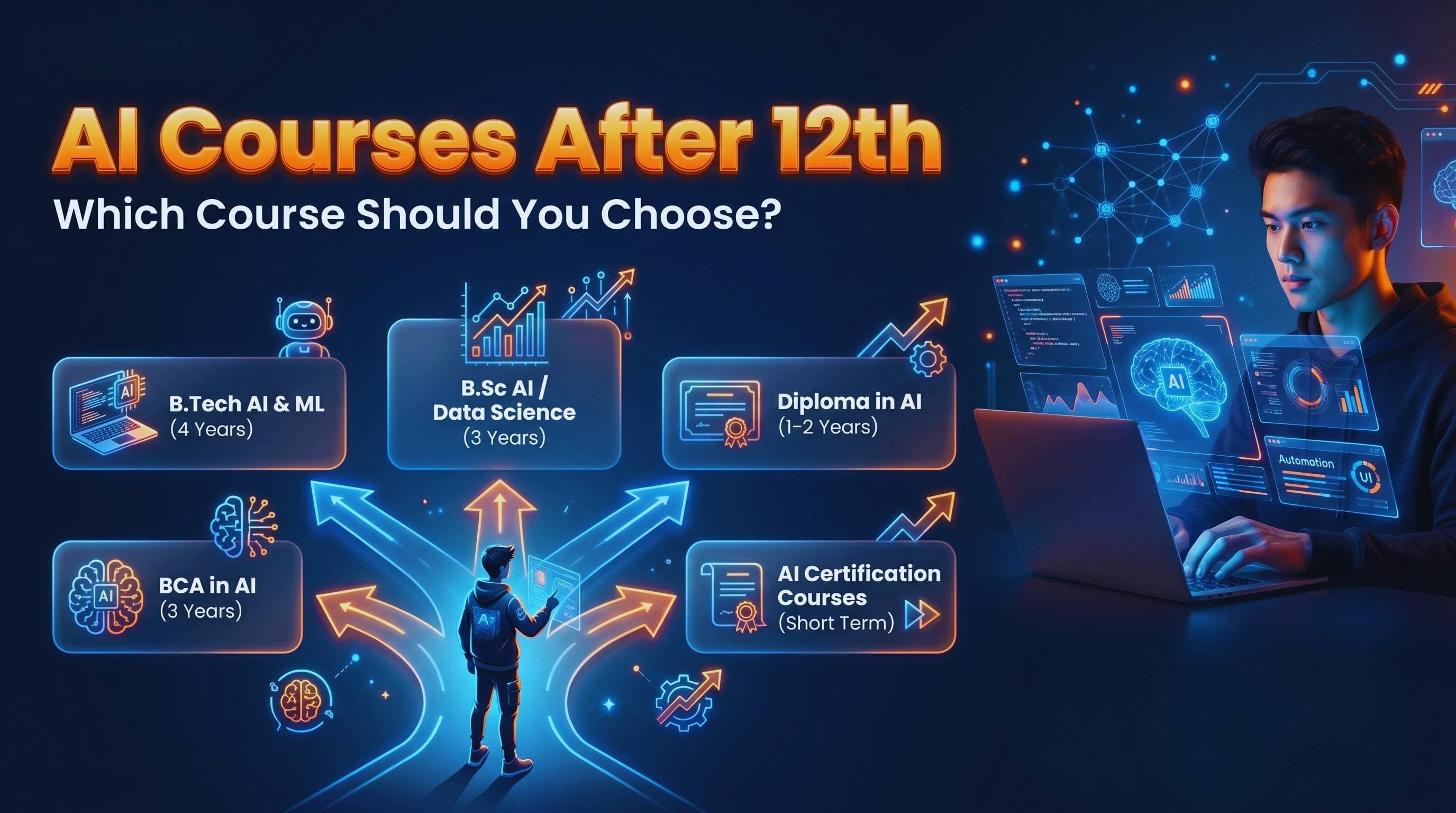
A bachelor's degree in computer science, IT, engineering, mathematics, or statistics can help you qualify for AI engineering roles. BCA and BSc graduates can also choose this career by developing the required technical skills and working on practical projects.
After Class 12, students can pursue a degree while learning Python and mathematics. If you are a non-technical graduate, you can start with Python and data analytics before moving on to machine learning.
Different employers may have different eligibility requirements, so check the job description before applying.
Skills You Need to Become an AI Engineer
Here are some important skills you should learn to become an AI engineer.
1. Python Programming
Learn variables, loops, functions, data structures, and object-oriented programming. You should also practise using popular Python libraries such as NumPy, Pandas, and Matplotlib for data analysis. If you are new to programming, start with our Python course to build a strong foundation.
2. Mathematics and Statistics
Learn linear algebra, probability, statistics, and basic calculus. These concepts will help you understand how machine learning models work. You can strengthen your fundamentals through our Mathematics and Statistics course.
3. SQL and Data Management
Learn SQL commands such as SELECT, WHERE, GROUP BY, and JOIN. Practise retrieving, filtering, and organizing datasets to improve your data-handling skills. Explore our SQL training course to develop practical database skills.
4. Machine Learning
Learn about supervised and unsupervised learning, regression, classification, clustering, and model evaluation. You can use Scikit-learn to build and test machine learning models. Our Machine Learning course can help you understand these concepts through practical learning.
5. Deep Learning
Learn about neural networks and practise using frameworks such as PyTorch or TensorFlow. You can also explore image classification and transformer-based models. Practical projects can help you understand how deep learning works.
6. NLP and Generative AI
Learn text processing, embeddings, prompt design, and retrieval-augmented generation (RAG). These skills can help you build chatbots and AI applications that answer questions using documents. Explore our Generative AI course to learn more about AI applications.
7. Cloud Computing and MLOps
Learn Git, GitHub, FastAPI, Docker, and the basics of Microsoft Azure. Practise deploying a model so that users can access it online. You can also explore cloud technologies to understand how AI applications are deployed and managed.
8. Communication and Problem-Solving
Practise explaining your projects, presenting results, and describing the limitations of your models. These skills are useful when working with both technical and non-technical teams.
AI Engineer Roadmap: Step by Step
This roadmap is designed for beginners who can study around 10 hours per week. Your timeline may be different depending on your background and how much you practise.
| Step | Timeline | What to Learn |
|---|---|---|
| 1 | Month 1 | Python fundamentals |
| 2 | Months 1–2 | NumPy, Pandas, SQL, and mathematics |
| 3 | Months 2–4 | Machine learning and Scikit-learn |
| 4 | Months 4–6 | Neural networks and deep learning |
| 5 | Months 6–8 | LLMs, APIs, Docker, and cloud basics |
| 6 | Months 8–10 | Projects, portfolio, and interview preparation |
Start by writing small Python programs. Then practise data analysis and learn machine learning algorithms using publicly available datasets.
After learning deep learning, move on to LLMs and build a simple AI application. Finally, upload your projects to GitHub, prepare your resume, and apply for internships and entry-level roles.
For many beginners, it may take around 8 to 12 months of consistent study to develop entry-level skills. This is only an estimate, not a guarantee.
AI Projects for Beginners
Projects help you apply what you have learned and demonstrate your practical skills to employers.
| Project | Skills Used | What You Will Build |
|---|---|---|
| House Price Predictor | Python, Pandas, Scikit-learn | A model that predicts house prices |
| Spam Message Classifier | NLP, Machine Learning | A model that detects spam messages |
| Image Classifier | Deep Learning, PyTorch | A model that classifies images into categories |
| Resume Screening Tool | Python, NLP | A tool that extracts skills from resumes |
| Document Chatbot | LLMs, Embeddings, RAG | A chatbot that answers questions based on documents |
| Sales Forecasting Dashboard | Python, Machine Learning | A dashboard that predicts future sales |
For each project, explain the problem, dataset, tools, approach, and results. Upload your code to GitHub and deploy at least one project using FastAPI or a cloud platform.
AI Engineer Salary in India
AI engineer salaries in India vary based on experience, location, company, technical skills, and job responsibilities. The table below shows broad indicative annual salary ranges. Actual offers can vary widely.
| Experience Level | Experience | Indicative Annual Salary |
|---|---|---|
| Fresher / Entry Level | 0–2 years | ₹3–8 LPA |
| Mid-Level | 3–6 years | ₹8–25 LPA |
| Senior Level | 7+ years | ₹25–50+ LPA |
These are broad reference ranges, not guaranteed salaries or official pay scales. Salary figures differ across job titles and employers. To understand current salaries, compare recent job listings and salary reports for your city and experience level.
AI Engineer Jobs for Freshers
Freshers can explore several entry-level roles in the AI field, including:
- Machine Learning Trainee
- Junior AI Developer
- Junior Data Scientist
- NLP Associate
- Python Developer
- Data Analyst
Create a portfolio to showcase your Python and machine learning skills. Apply for internships, participate in hackathons, and practise explaining your projects.
Search LinkedIn, Naukri, and company career pages for job openings. If you cannot find an AI engineering role immediately, consider related Python or data analyst jobs while continuing to improve your AI skills.
AI Engineer Career Path
The career path of an AI engineer can include several stages, depending on the company and your specialization.
| Career Stage | Typical Responsibilities |
|---|---|
| AI/ML Trainee | Help with data preparation and model development |
| Junior AI Engineer | Build and test models with guidance |
| AI Engineer | Build and deploy AI applications |
| Senior AI Engineer | Design AI systems and guide technical decisions |
| AI Lead / Architect | Design AI solutions and lead projects or teams |
With more experience, you can specialize in areas such as natural language processing, computer vision, generative AI, or MLOps.
Choosing an AI Engineering Course
For beginners, a structured course can provide a learning plan and practical experience. Before enrolling in an AI Engineer Course in India, check these five things.
1. Course Syllabus
Look for a syllabus that includes Python, mathematics, machine learning, deep learning, NLP, and model deployment.
2. Practical Projects
Choose a course that includes hands-on assignments and projects you can add to your portfolio.
3. Trainer Support
Check the trainer's experience and whether learners receive feedback and help with technical questions.
4. Duration and Fees
Compare the schedule, course duration, and fees. Check whether labs, learning materials, and project reviews are included.
5. Placement Assistance
Some institutes offer an AI Course with Placement Assistance, which may include resume reviews, mock interviews, and career guidance. Placement assistance does not guarantee a job, so check exactly what the institute provides.
Compare available programs and choose an AI Engineering Course that matches your learning needs, schedule, and career goals.
Common Mistakes to Avoid
While learning AI, try to avoid these common mistakes:
- Moving to deep learning without learning Python fundamentals.
- Collecting certificates without building practical projects.
- Copying tutorial projects without understanding the code.
- Trying to learn too many tools at once.
- Ignoring mathematics and model evaluation.
- Waiting too long to apply for internships or entry-level jobs.
Stay consistent, understand the projects you build, and improve your skills one step at a time.
Conclusion
To become an AI engineer in India, you need to keep learning and gaining practical experience. Start with Python, mathematics, and SQL. Then learn machine learning, deep learning, and generative AI.
Build projects, publish your work on GitHub, and prepare for interviews. Once you have a good foundation, you can start applying for internships and entry-level jobs.
If you are looking for structured learning and hands-on guidance, explore the AI engineering course options at SoftCrayons. Check the syllabus, projects, and available support to choose a program that fits your learning needs and career goals.